


3000K vs 4000K: Choosing White Light
Compare warm and more neutral white light on real cabinet finishes, clothing and benchtop samples. Learn when fixed white or tunable white suits the way a room is used.
VOXAURA
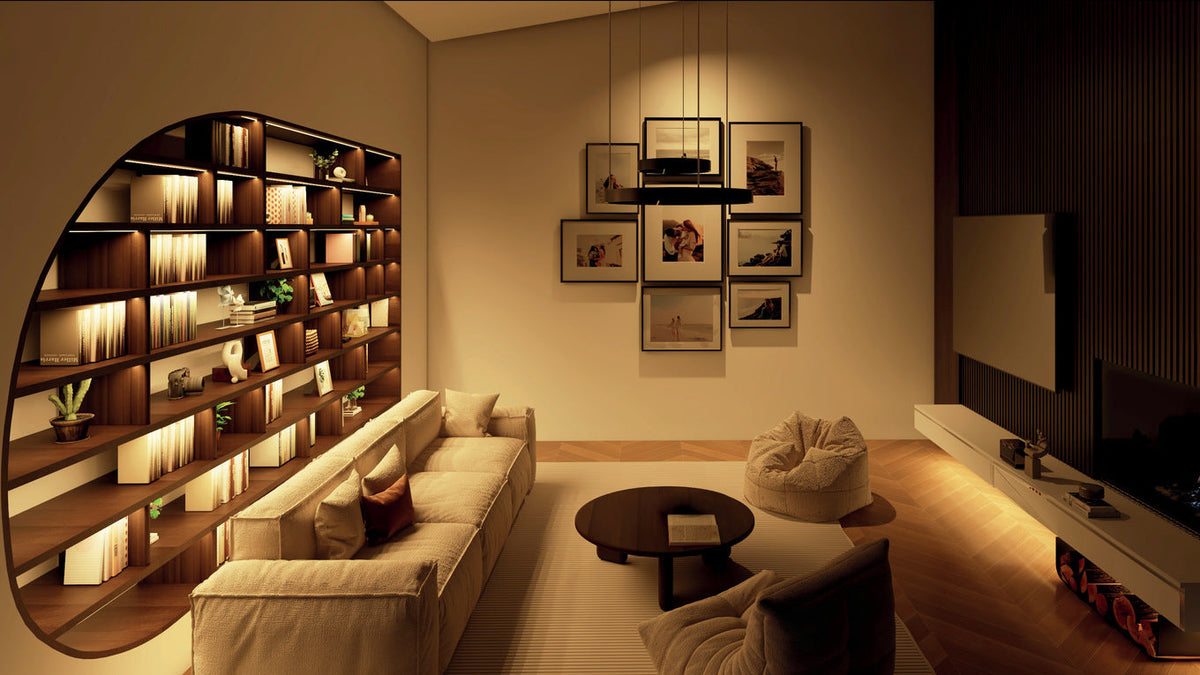
3000K gives a warmer white appearance, while 4000K looks more neutral. Either can work in a kitchen or wardrobe. Choose by comparing the light on your actual finishes, alongside the room's other lighting. If you want to change the white appearance after installation, consider tunable white and its matching controls.
Colour temperature is one part of the decision. You also need enough light in the right place, good colour rendering and a control method that suits everyday use.
What does the K number tell you?
The K value is a shorthand for the warm or cool appearance of white light. The technical term is correlated colour temperature, or CCT.
A lower value such as 2700K generally looks warmer. At 3000K, the light is commonly described as warm white. At 4000K, it looks more neutral alongside those warmer sources. Descriptions such as “warm” and “cool” can vary between suppliers, so keep the actual number in your specification.
The US Department of Energy's colour-characteristics guide also explains why CCT is only a summary of colour appearance. Two lights carrying the same nominal K value can still look slightly different.
A practical 3000K vs 4000K comparison
| Choice | Appearance | A useful sample comparison |
|---|---|---|
| 3000K | Warmer white | Timber, warm cabinet finishes and a kitchen adjoining a warmly lit living area |
| 4000K | More neutral white | Benchtop materials, clothing and tasks where you prefer that white appearance |
| Tunable white | Adjustable within the selected product's range | A space where one fixed appearance does not suit all intended activities |
These are places to start a comparison, rather than rules for particular rooms. A white kitchen can work with warm lighting, and a timber wardrobe can work with a more neutral setting.
Use samples to establish which combination you prefer. A small difference on a white test card can become more noticeable across a long splashback or several adjacent wardrobe bays.


Is 4000K brighter than 3000K?
The K number describes colour appearance. To compare output, check lumens. To assess illumination on a benchtop or shelf, consider lux and the layout.
Different colour-temperature variants within one range can have different published outputs. That is a product characteristic you can check, rather than something established by the K number alone.
For example, the VoxAura Australian catalogue lists the LS4030 3000K strip, article 200.10.00.026, at 475lm/m. Its 4000K version, article 200.10.00.027, is listed at 500lm/m. Both are rated at 5W/m.
Those values describe those particular strips. They do not show how bright every point of your finished cabinet will be. Position, mounting distance, diffuser and obstructions still affect the result.
How to choose kitchen lighting colour temperature
Start with the preparation area. Put a cabinet-door sample, benchtop sample and splashback material together, then compare the candidate lights from a realistic mounting position.
Look for changes in the material's appearance. Does the stone look the way you expected? Does the light sit comfortably beside the ceiling fittings? In an open-plan kitchen, also view it from the living or dining area.
Repeat the comparison after dark. Daylight can mask differences between artificial sources that become obvious in the evening.
If you prefer one appearance for preparing food and another for a quieter evening, assess tunable white. Also plan dimming and lighting groups. A lower-output ambient setting may meet the evening brief even where you keep one fixed colour temperature.
What works for wardrobe and dressing-area lighting?
Compare the light on several items of clothing and the cabinet finish. Include colours and fabrics you use often. Then check the dressing area alongside any nearby mirror or bedroom lighting.
Clothing and shelves can obstruct the light, so test with garments in place. Selecting 4000K will not correct a fitting hidden behind a full rail of clothes.
Colour rendering needs its own check. Two products with the same colour temperature can render fabrics differently. Review the exact light's CRI data and, where available, additional colour information before making the final choice.
Fixed white, dimming and tunable white: what changes?
These functions answer different needs:
- Fixed white: You select a colour-temperature variant when ordering.
- Dimming: A compatible system changes the light level.
- Tunable white: Compatible light channels and controls allow the white appearance to change.
Within the VoxAura range discussed here, a standard fixed-white MC light retains its selected colour temperature when dimmed. A different remote cannot add adjustable-white capability to that light.
Tunable white is useful when flexibility is part of the brief. It also means selecting the adjustable-white light and the appropriate controller and input, rather than adding that requirement after the fittings have been ordered.
A VoxAura example: choosing the right variant
The Australian catalogue lists PL4000 recessed linear lighting in fixed-white and Multiwhite versions. A black 3000K fixed-white example is article 201.10.21.001. The black Multiwhite version is article 201.11.21.001, with a published 2700–5000K range.
Those are different ordering choices. Confirm the full article number, connector and compatible control route.
The catalogue also includes LS4031 Multiwhite strip, article 200.11.00.002. Its adjustable-white function requires the appropriate smart-driver and matching control-unit arrangement. A two-pin connection on both a fixed-white and Multiwhite product does not establish electrical interchangeability.
Ask the supplier to quote a working combination of light, driver, control unit, input and connection parts.
Does tunable white change automatically?
Automatic changes require a configured trigger or schedule and supported control functions. A tunable-white light can also be operated manually through a compatible local control.
Describe the behaviour you want in plain terms. For example: “I want a brighter preparation setting I can select manually, and a warmer setting for the evening.” If you also want those changes to happen at set times, include that requirement.
Then confirm how the selected controls handle brightness, white tuning and groups. Check what happens after someone makes a manual adjustment. This helps avoid a schedule unexpectedly changing a setting the user has just chosen.
A simple comparison to make before ordering
- Compare the proposed lights on the actual materials.
- Keep the mounting position and illumination as similar as practical.
- View them beside the other lights that will remain in the room.
- Check both daytime and evening conditions.
- Demonstrate any dimming and white-tuning functions.
- Record the selected article numbers and complete control combination.
Keep the sample information with the cabinet drawings so the lighting choice survives the move from design to ordering.
Frequently asked questions
Should all the lights in a home use the same K value?
Plan the relationship between spaces. Adjacent lights seen together deserve a sample comparison; different rooms can have different requirements.
Can I change a 3000K strip to 4000K in an app?
Only if the installed light and control system support adjustable white. A standard fixed-3000K variant remains that colour temperature.
Is tunable white the same as RGB?
They provide different functions. Tunable white adjusts white appearance; RGB creates colour effects. Some products combine colour and dedicated white channels.
Do I need an app for tunable white?
Compatible local controls can provide white tuning. Confirm the available functions for the selected light and controller.
Choose the white light as part of the whole room
Bring Knox System your cabinet layout, finish samples and preferred lighting behaviour. We can help identify a suitable VoxAura fixed-white or Multiwhite configuration before the cabinetry is finalised.