


LED Driver Sizing for Cabinet Lights
Calculate the connected lighting load, then check voltage, driver capacity, controls, ports and cable limits. A complete system check matters more than wattage alone.
VOXAURA
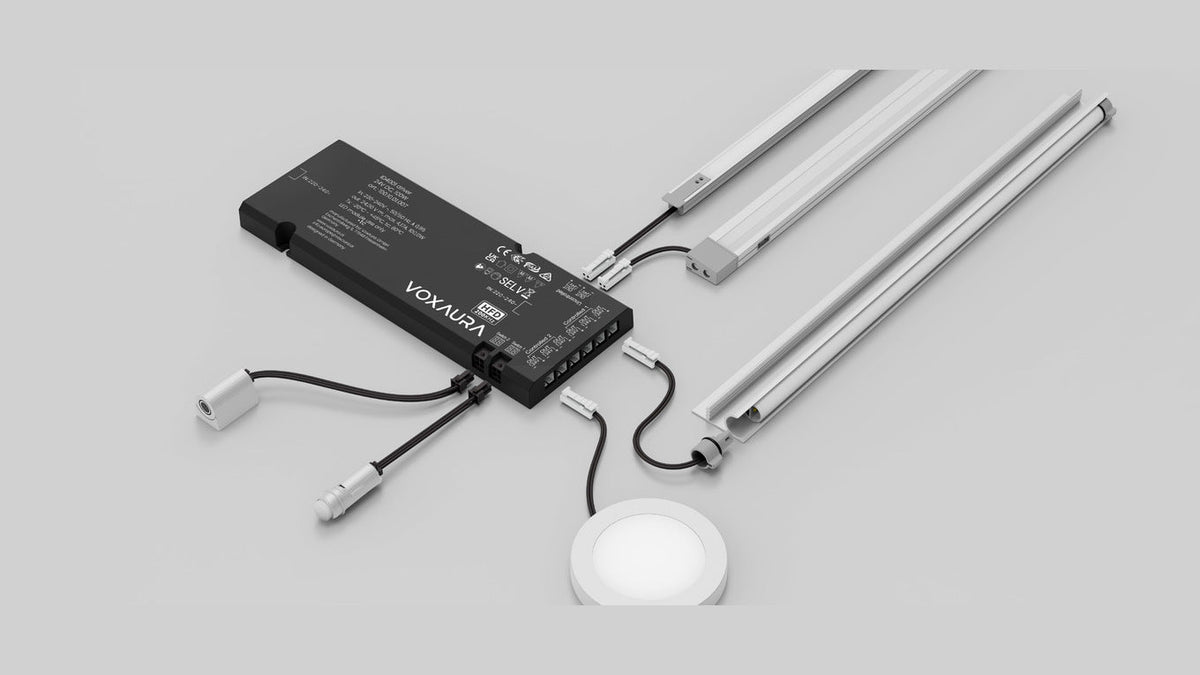
To choose an LED driver for cabinet lights, match the required output voltage and supply type, calculate the maximum connected load, then check the controller, connections, cable lengths and installation conditions. Wattage is a starting point for the selection.
For a VoxAura cabinet-lighting project, the light and control requirements also determine whether an integrated wired route or a modular smart route is appropriate. Here is how to work through that decision with a clear load calculation.
Start with the lighting specification
Record the exact light and variant before selecting the power supply. A useful specification includes the voltage, power per metre or per fitting, installed length, light type and required control functions.
Many cabinet systems use a low-voltage DC supply. That description alone is insufficient to match products: a light specified for 24V DC needs the compatible supply and control arrangement. Constant-voltage and constant-current products also have different requirements. Use the light manufacturer's specified driver path.
In the VoxAura Australian catalogue, the relevant furniture-lighting system uses compatible 24V products. Connectors, colour channels and controls still need to match the selected light. A connector that fits physically does not establish compatibility.
Calculate the installed load
For a strip or linear light specified in watts per metre:
Light load = installed length × watts per metre
For individual fittings:
Light load = number of fittings × watts per fitting
Add all loads that may operate simultaneously on the same supply. Use the actual installed lengths, including every separate section.
Consider this illustrative cabinet project:
| Light | Calculation | Load |
|---|---|---|
| Two linear-light sections, each 1.5m at 5W/m | 2 × 1.5 × 5 | 15W |
| Three downlights, each 2.5W | 3 × 2.5 | 7.5W |
| One 1m drawer-light section at 5W/m | 1 × 5 | 5W |
| Total light load | 15 + 7.5 + 5 | 27.5W |
These are example loads, not a complete product combination. A compatible 40W model in the catalogue is a capacity candidate for 27.5W. The controller arrangement, sensor supply path, ports, wiring and operating conditions still need checking.
Calculate using the maximum possible simultaneous operation. A plan to dim the lights during normal use does not remove the possibility of full output.
Choose capacity using the driver's actual rating
A driver's output rating describes the load it can supply under its specified conditions. A 60W supply connected to a smaller load does not continuously send 60W into the lights. The connected system draws the power it requires, with additional losses on the input side.
Follow the manufacturer's loading and installation requirements. Some supplies have temperature or input-condition derating, and different products have different limits. A fixed percentage rule should not replace that information.
Compare the calculated maximum simultaneous load with the selected driver’s rated output under its specified operating and installation conditions. Confirm any derating and planned expansion with the supplier.
If you expect to add more lights, include the proposed extension in the calculation and check the entire system again. Reserving expansion capacity can be useful, but the future lights must also fit the wiring and controls.
Check the limits between the driver and the lights
Power passes through several components. Every part must suit the proposed load.
- Driver total output: all connected loads share its capacity.
- Control-unit rating: the controller has its own limits.
- Individual ports and connectors: one connection may have a lower limit than the complete system.
- Cables: length, conductor size and connections affect the result.
- Continuous light runs: a strip has its own permitted run length.
- Operating conditions: mounting position, temperature and ventilation affect the installation.
A distributor provides additional connection positions within the specified limits. It does not increase the driver's wattage or the rating of the port feeding it. It also does not automatically make each connected light independently controllable.
Why a larger driver may not fix a dim strip end
An extended cable or long continuous strip can have voltage drop. The light at the far end may therefore receive less voltage than the light near the supply.
A higher wattage rating at the same specified output voltage does not automatically solve the route or run-length problem. Check the permitted strip length, cable arrangement and connections. The supplier may recommend an approved branch or feed configuration.
For example, the Australian catalogue lists a maximum visible continuous length of 5m for LS4030. More total power capacity does not turn that specification into an unlimited single run. If a design needs a longer illuminated distance, the supply and section layout need planning together.
Keep cable distance and strip length as separate measurements. The distance from the driver to a cabinet is different from the illuminated length inside that cabinet.
Match the driver route to the controls
The required operation can change the system choice.
A basic wired arrangement may suit a customer who wants fixed-white cabinet lights operated from a compatible touch, swipe or door sensor. In the VoxAura integrated route, the matched driver handles the supported wired control.
The modular smart route uses a smart driver with an appropriate control unit. The control unit must suit the light's colour system and the required grouping. Adjustable white light requires the relevant light channels and compatible control hardware.
Choose independent lighting areas before finalising the components. A larger driver can provide more total capacity within the system limits, while independent zones require the appropriate control arrangement.
Sensor-operated drawer or rail lights also need their specified supply path. Include their loads in the total even if they operate differently from the main lighting group.

Plan access and installation space
Reserve the driver and controller location while the cabinetry is being designed. Keep required connections and control access reachable for servicing and commissioning.
Follow the specified clearances and mounting conditions. A cavity that physically holds the driver may still be unsuitable if it traps heat or prevents access. Check the complete enclosure and the nearby materials.
Select suitable components for the actual environment. A light's protection rating does not establish the rating of its driver, controller or connections.
Questions to ask before ordering
Bring a simple load schedule to your supplier:
- What are the exact light variants and their electrical requirements?
- What length or quantity of each light will be installed?
- What is the total possible simultaneous load?
- Which lights need separate control or their own sensor supply?
- Do all ports, cables, connections and continuous runs meet their limits?
- Does the planned location meet the installation requirements?
Ask for the complete bill of materials, including the necessary controller, connection leads, end parts and mounting accessories.
Frequently asked questions
Can I use any 24V LED power supply?
Matching voltage is one part of the selection. Also match the supply type, control method, load, connections and installation requirements. For the VoxAura system discussed here, use the specified compatible VoxAura power and control components.
Should I always use only 80% of an LED driver's rating?
Follow the exact manufacturer's requirements. A universal 80% rule is not a substitute for the product's rating and operating conditions.
Does a 100W driver always use 100W of electricity?
The input depends on the connected load, driver efficiency and operating state. Rated output capacity is different from actual consumption.
Can I add more lights through a splitter?
Only within every applicable system limit. Recalculate the total load and check the feeding port, wiring and controls.
Planning a cabinet-lighting system?
Talk to Knox System about a matched VoxAura configuration. Bring your cabinet layout, lighting lengths and control requirements so the power supply, controller, lights and accessories can be selected together.