


CRI and R9 for Cabinet Lighting
Read CRI, Ra and R9 alongside a sample of the materials you want to show. Understand what colour-rendering figures can establish and why the exact light variant matters.
VOXAURA
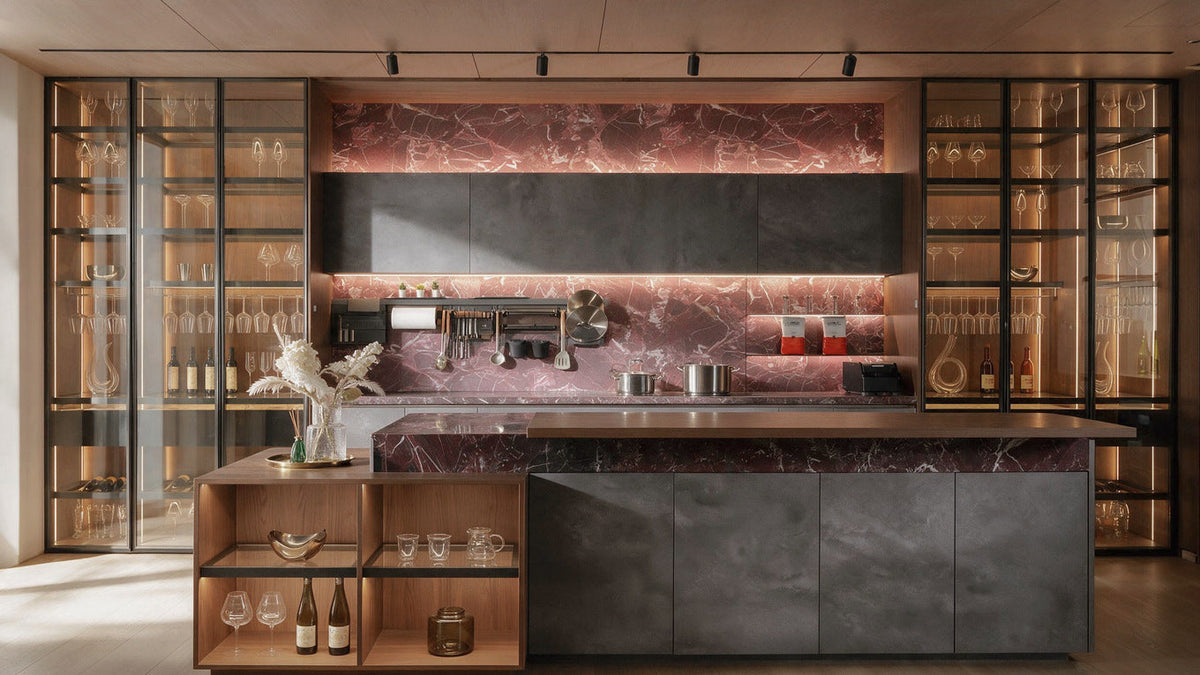
CRI helps you compare how white light renders object colours against a reference. R9 adds information about strong-red rendering that the usual CRI average leaves out. For cabinetry where materials matter, use both the product data and a sample on your actual finishes.
A high CRI value is a useful selection tool, but it does not tell you the light's brightness, white colour temperature or suitability for a particular cabinet. Here is how to use the information without losing sight of the finished room.
What does CRI mean in lighting?
CRI stands for colour rendering index. It describes how colours under a light compare with the same colours under a reference source of comparable colour temperature. That comparison is central to the Illuminating Engineering Society's definition.
The value normally quoted as CRI is Ra, the general colour rendering index. It averages the results for eight standard test colours. NIST's explanation of colour rendering describes that calculation and its limitations.
A value of Ra93 therefore does not mean “93% of all colours are accurate”. It is the result of a particular test method. Two lights with the same Ra can still differ in their rendering of particular materials.

What is R9, and why look for it?
R9 is a separate index for a strong-red test colour. It sits outside the eight-colour average used for Ra.
The US Department of Energy's LED guide identifies saturated-red rendering as a weakness of the usual CRI summary and explains the role of R9.
That extra information is useful when the brief involves red materials or colours that contain a significant red component. In a home, those might include fabrics, food or warm finishes. Check familiar samples rather than assuming one index predicts the appearance of every object.
When a catalogue states R9 above 50, that is the reported boundary for that product. It should not be read as 50% colour accuracy or as a guarantee that every specialist display requirement has been met.
CRI, colour temperature and brightness answer different questions
| Information | What it helps you assess | What to check alongside it |
|---|---|---|
| CCT, such as 3000K or 4000K | The warm or cool appearance of white light | Adjacent lights and the material sample |
| CRI / Ra | Average colour fidelity under the test method | R9 and the project's particular colours |
| R9 | Rendering of the strong-red test sample | The overall colour data and actual materials |
| Lumens | Published light output | The fitting and its optical components |
| Lux | Illumination reaching a surface | Distance, position, obstructions and measurement conditions |
A 3000K product and a 4000K product can both have high CRI while creating different room appearances. Likewise, a high-CRI light can leave a shelf dark if clothes or cabinet edges block its output.
Choose the white appearance, colour quality and lighting layout together.
Is CRI 90 or above worth considering for cabinetry?
CRI 90 or above is a useful starting criterion when the appearance of timber, clothes or other finishes is a priority. The DOE describes this level as providing excellent colour fidelity.
For a kitchen, compare food and finish samples on the benchtop. For a wardrobe, include several familiar garments. For a display cabinet, assess the items that will actually be shown.
The final decision also depends on the available output, fitting dimensions and control functions. A higher headline number is only useful when the product can meet the rest of the brief.
If a designer requests Ra above 95, a particular R9 value or additional colour data, record that requirement before choosing the products. A catalogue value of Ra93 does not satisfy a requirement above 95.
What do the VoxAura catalogue figures apply to?
The Australian catalogue includes the following specific white-light examples:
| Product and selected variant | Article number | Published Ra | Published R9 |
|---|---|---|---|
| LS4000 SMD strip, 3000K | 200.10.00.002 | 93 | Above 50 |
| LS4030 COB strip, 3000K | 200.10.00.026 | 93 | Above 50 |
| PL4000 linear light, black, 3000K | 201.10.21.001 | 93 | Above 50 |
These are published values for the identified catalogue variants. Confirm the current data for the product in your quotation.
They also illustrate why the construction name gives only part of the picture. An SMD strip, a COB strip and an integrated linear light can each have specified colour-rendering values. Use the exact product row rather than transferring a claim between them.
For adjustable-white lighting, request the relevant data for the proposed version and operating settings. For RGB products, distinguish a specified white-light mode from coloured effects.
How to compare samples fairly
A sample comparison helps connect the specification to your preferences. Keep the conditions consistent:
- Use the same material or item under each light.
- Compare at the intended white colour temperature where practical.
- Keep illumination and mounting position as similar as possible.
- Use the proposed profile and diffuser.
- Reduce interference from other light sources for the comparison.
- Repeat the check with the room's normal lighting operating.
Include more than one material. A light that suits the timber sample may create a different impression on the adjacent stone, fabric or painted door.

Keep the selected article number, colour temperature and fitting components with the samples. A later substitution should be checked against the same brief.
Can a photograph prove colour quality?
Photographs can document the sample setup, but camera white balance, exposure and the screen affect what viewers see.
Use images to show where the light sits and which products were compared. A manufacturer's test report supplies the technical evidence for a numerical colour-rendering claim. A photograph on its own cannot establish Ra93 or a particular R9.
For an important finish decision, inspect the sample in person where possible. Record the lighting conditions so that everyone reviewing the choice understands what was compared.
When might a designer ask for more than CRI?
Some projects need a more detailed description of colour rendition. A designer may request TM-30 information in addition to Ra and R9.
TM-30 provides broader information about fidelity and changes in colour saturation, with graphical results that can help explain particular colour shifts. The DOE's TM-30 introduction outlines those differences.
Ask for a report for the exact product and relevant setting. An Ra number alone cannot supply missing TM-30 values. Where those data are unavailable, make that gap clear before approving a specification that depends on them.
Frequently asked questions
Does CRI 100 mean the light is daylight?
CRI compares a source with a reference of comparable colour temperature. A perfect test score does not identify the light as daylight or specify its K value.
Is higher CRI always brighter or more efficient?
Check lumens, electrical load and the complete fitting separately. CRI measures a different characteristic.
Can two Ra93 lights make timber look different?
Yes. The average score does not capture every colour difference. Compare the actual products on the chosen timber.
Will high CRI fix poor lighting placement?
It cannot remove shadows caused by cabinet structure or clothing. Plan coverage and visual comfort alongside colour quality.
Specify the light for the materials you want to show
Bring Knox System your material samples and any designer requirements. We can help compare appropriate VoxAura options and check the colour data, output, fitting and controls for the selected product.